
FCom Fuji Crystal · FSF-5050 Series · SAW Filter
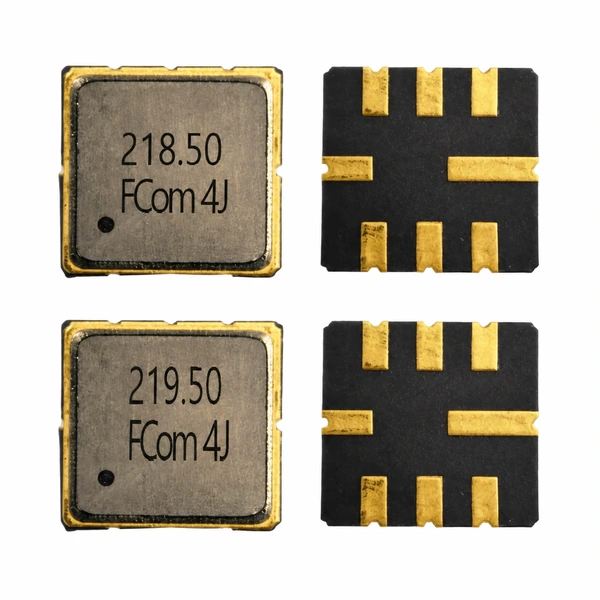
218.5 & 219.5 MHz SAW Filters
FSF-5050-218M5 · FSF-5050-219M5
Two close-frequency options for VHF receivers and RF / IF signal selection in a 5.0 × 5.0 mm SMD package. Confirm each model’s specified passband, loss definition and interface conditions before selecting.
Choose by passband definition
Two close frequencies, separate specifications
The two models share a package format, but their center frequency, passband, loss definitions and operating limits must be confirmed from the applicable FCom datasheet pages. Do not infer performance from the other model or from the shared package.
SAW Filter · 218.5 MHz
FSF-5050-218M5
218.5 MHz
Specified passband interval — pending confirmation from the FCom datasheet.
- Specified passband
- — (待确认)
- 3 dB bandwidth
- — (待确认)
- Insertion loss
- — (待确认)
- Amplitude ripple
- — (待确认)
- Operating temperature
- — (待确认)
- Source / load test termination
- — (待确认)
SAW Filter · 219.5 MHz
FSF-5050-219M5
219.5 MHz
Specified passband interval — pending confirmation from the FCom datasheet.
- Specified passband
- — (待确认)
- 3 dB bandwidth
- — (待确认)
- Insertion loss
- — (待确认)
- Amplitude ripple
- — (待确认)
- Operating temperature
- — (待确认)
- Source / load test termination
- — (待确认)
Do not infer performance from close frequency spacing. 218.5 MHz and 219.5 MHz are separate products with their own specified passbands, loss definitions and limits. A shared package does not establish interchangeability.
Six key parameters per model
Electrical specifications
Placeholder structure only. Values below must be replaced with the confirmed FCom datasheet data for each model before publication. No value has been estimated or copied from another frequency page.
Scroll horizontally to view all columns.
FSF-5050-218M5
| Parameter | Min. | Typ. | Max. | Unit | Definition / condition |
|---|---|---|---|---|---|
| Center frequency | — | — | — | MHz | Nominal value 218.5 MHz; confirm whether it is a stated or tolerance-limited value. |
| Specified passband for IL and ripple | — (待确认) | MHz | Provide the exact interval from the FCom datasheet. | ||
| 3 dB bandwidth | — | — | — | MHz | State the dB reference (absolute or ILmin) and whether min./typ./max. |
| Insertion loss | — | — | — | dB | Confirm whether IL applies over the whole passband or only at center frequency. |
| Amplitude ripple | — | — | — | dB | Provide the ripple test interval and any reference level. |
| Operating temperature | — | — | — | °C | Separate operating and storage limits. Do not infer from other FSF-5050 models. |
“—” means not yet confirmed. Do not publish until each cell is replaced with the FCom datasheet value. Stopband reference, source/load terminations and maximum ratings must also be confirmed separately.
FSF-5050-219M5
| Parameter | Min. | Typ. | Max. | Unit | Definition / condition |
|---|---|---|---|---|---|
| Center frequency | — | — | — | MHz | Nominal value 219.5 MHz; confirm whether it is a stated or tolerance-limited value. |
| Specified passband for IL and ripple | — (待确认) | MHz | Provide the exact interval from the FCom datasheet. | ||
| 3 dB bandwidth | — | — | — | MHz | State the dB reference (absolute or ILmin) and whether min./typ./max. |
| Insertion loss | — | — | — | dB | Confirm whether IL applies over the whole passband or only at center frequency. |
| Amplitude ripple | — | — | — | dB | Provide the ripple test interval and any reference level. |
| Operating temperature | — | — | — | °C | Separate operating and storage limits. Do not infer from other FSF-5050 models. |
“—” means not yet confirmed. Do not publish until each cell is replaced with the FCom datasheet value. Stopband reference, source/load terminations and maximum ratings must also be confirmed separately.
Typical Applications
VHF signal selection and IF filtering
VHF receiver filtering
Select the model aligned with the receiver’s VHF frequency plan and required signal bandwidth.
RF front-end signal selection
Use the specified passband and stopband limits to assess wanted-signal loss and out-of-band rejection.
Superheterodyne IF stages
Evaluate the selected filter between the actual preceding and following IF stages, including source and load conditions.
Functional application example only. This is not a validated schematic, pin-routing diagram or measured response.
Design-in essentials
Confirm interface and limits per model
Source, load and matching
The applicable FCom datasheet must be checked for each model’s stated source/load terminations and any required external matching network.
Do not assume that 218M5 and 219M5 share the same matching values or port impedances because of their close frequencies.
Operating limits and ratings
Maximum RF input power, maximum DC voltage, operating and storage temperature must be confirmed from the FCom datasheet for each model.
Keep RF traces short and connect ground and case-ground pads according to the FCom pin assignment. Maximum ratings are limits, not recommended operating targets.
Package & Pin Assignment
Package and pin assignment
Package outline and pin functions must be confirmed from the applicable FCom drawing for each model before PCB release.
Package outline — to be confirmed from the FCom drawing.
The FSF-5050 series has been documented with a 5.0 × 5.0 mm, 8-pad SMD outline in other datasheets, but this page must not assume that format until the FCom drawing for 218M5 and 219M5 has been checked.
Confirm dimensions, height and pad orientation from the applicable mechanical drawing before assigning PCB pads.
| Pin(s) | Function |
|---|---|
| 2 | — (待确认) |
| 6 | — (待确认) |
| 1, 3, 5, 7 | — (待确认) |
| 4, 8 | — (待确认) |
Do not assume a common FSF-5050 pinout. Replace each row with the confirmed pin table from the FCom datasheet for the specific models before publishing.
Selection and Design-In Support
Share your frequency plan and interface requirements
Include the selected model, required center frequency, passband and bandwidth definition, source/load requirements and operating temperature. Add sample quantity, estimated usage and any blocker-frequency targets so the inquiry addresses your actual design.
Confirm the complete ordering code and applicable specification with FCom before ordering.
Engineering Questions
Frequently asked questions
Are 218M5 and 219M5 interchangeable because their frequencies are close?
No. Close center frequencies do not establish interchangeability. Each model has its own specified passband, loss definitions, rejection intervals and operating limits. Confirm each from its FCom datasheet page before substitution.
Why are the specification tables marked “待确认”?
The FCom datasheet pages for FSF-5050-218M5 and FSF-5050-219M5 were not included in the source material supplied for this draft. Parameters must not be inferred from other FSF-5050 models or from the shared package format. Each value must be replaced with the confirmed datasheet value before publication.
What does the specified passband interval mean?
The specified passband is the frequency interval over which insertion loss and amplitude ripple are specified. It is not automatically a 3 dB bandwidth. The 3 dB bandwidth, if given, uses its own dB reference and value type, and must be read separately.
Do 218M5 and 219M5 share the same source/load and matching conditions?
This has not been confirmed. Each model’s FCom datasheet page must be checked for its stated source/load terminations and any required external matching network. Do not assume identical interface conditions from the shared package alone.
Do the two models share the same operating temperature range?
This has not been confirmed. Operating and storage temperature must be read separately from each model’s FCom datasheet. Do not infer the range from other FSF-5050 models.
What information should be included in a technical inquiry?
Provide the selected model or center frequency, required passband and bandwidth definition, source/load requirements, operating temperature, sample quantity and estimated usage. Include blocker frequencies and rejection targets where relevant. Confirm the complete ordering code and applicable specification with FCom before ordering.