Frequency Control · Technical Guide
Crystal oscillator aging is the gradual change in frequency caused by internal changes over time. Understanding it helps engineers set realistic accuracy budgets, compare timing devices and plan calibration throughout a product’s service life.
FCom Fuji Crystal · Technical Guide
Accuracy, stability and aging
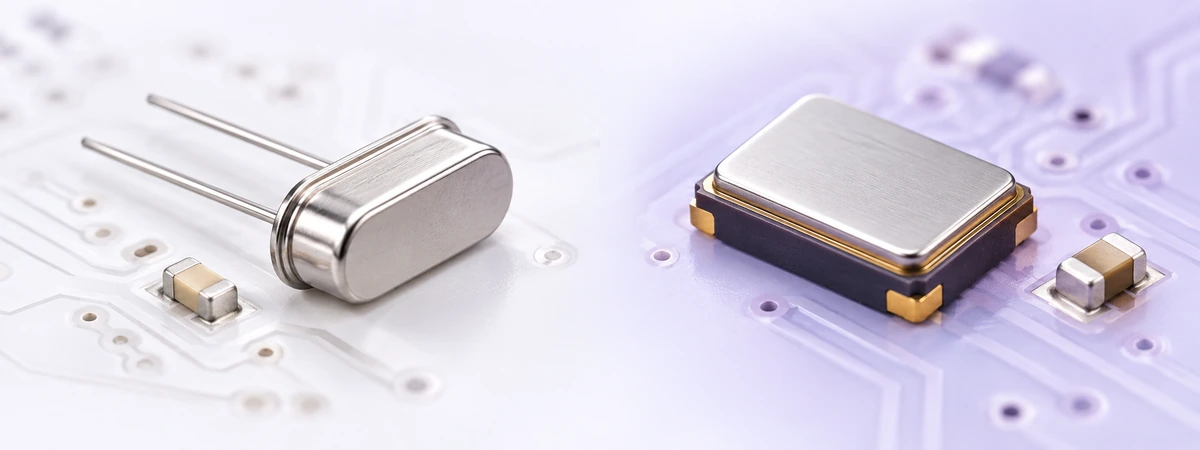
Quartz uses piezoelectric coupling to connect electrical excitation with mechanical resonance. Its high quality factor supports stable frequency selection, but does not eliminate environmental sensitivity or long-term change. A passive crystal requires an oscillator circuit; an active crystal oscillator combines the resonator with circuitry that produces a clock output. [1]
| Parameter | Meaning | What to check |
|---|---|---|
| Initial tolerance | Starting frequency offset from nominal. | Reference temperature, supply and load. |
| Temperature stability | Frequency variation over temperature. | Temperature range and reference convention. |
| Aging | Time-dependent change under defined conditions. | Duration, conditioning and temperature. |
| Retrace | Frequency offset after power removal and restart. | Off-time and subsequent warm-up time. |
| Total frequency tolerance | A combined limit for specified contributions. | Which effects and service interval are included. |
These terms are not interchangeable. In particular, a tight temperature specification does not establish the long-term aging limit. Retrace also needs separate attention in equipment that regularly powers down. [2]
What causes crystal oscillator aging?
Two important mechanisms are stress relaxation and changes in effective mass loading. Their relative contributions depend on the resonator, its mounting and the manufacturing process. [3]
- Stress relaxation: Residual stress in the quartz, electrodes and mounting structure changes over time, affecting resonance.
- Surface contamination: Material released inside the package can accumulate on vibrating surfaces and alter their effective mass.
Different mechanisms can produce opposing frequency shifts. Aging therefore need not have a universal direction, and the net trend can change. Do not interpret every downward drift as a package failure without further investigation. [3]
How to interpret aging rates
Aging is commonly greater early in operation and becomes slower after stabilization. Precision oscillator specifications may therefore define a daily rate only after a conditioning period. A first-year cumulative change and a later daily rate describe different quantities. Neither should be extrapolated across the full service life without supporting data. [2]
For each candidate, record:
- The maximum permitted change, with units of ppm or ppb.
- The measurement interval and the point from which it begins.
- Temperature, power state and any required stabilization period.
- Whether the value is guaranteed or typical.
- Whether aging is already included in the total frequency tolerance.
For example, Epson explicitly includes aging at +25°C over ten years in the stated tolerance of its SG-8018CA. This illustrates why the specification notes matter; it is not a general aging allowance for other oscillators. [4]
Frequency and time-error examples
Convert fractional frequency error into hertz using:
Frequency offset (Hz) = nominal frequency (Hz) × error (ppm) × 10−6
Illustrative example: At 10 MHz, a 1 ppm offset equals 10 Hz. A constant 1 ppm clock error accumulates 0.0864 seconds in one day:
86,400 s × 1 × 10−6 = 0.0864 s
These are calculated examples, not FCom product measurements.
An end-of-year aging value does not mean that the final offset existed throughout the year. As a mathematical illustration, if the aging contribution rises linearly from zero to +1 ppm over 365 days, its average is +0.5 ppm and the accumulated time error is 15.768 seconds. Actual aging is often nonlinear, so use measured behavior or a validated model for prediction.
For a conservative design budget, add the magnitudes of applicable maximum error contributions. An illustrative allowance of ±10 ppm initially, ±15 ppm over temperature and ±3 ppm aging gives ±28 ppm before any additional supply, load or assembly allowance. This arithmetic assumes separate limits that may align in the same direction. Do not add aging again when a manufacturer’s combined tolerance already includes it.
Design and measurement practices
Match the circuit and operating conditions
For passive crystals, match load capacitance and verify drive level. Load mismatch shifts operating frequency, while excessive drive can introduce instability. Correcting these errors improves the design but does not remove intrinsic aging. [1]
Define the required service interval
State how long equipment must operate between calibrations. For network or measurement systems, also define holdover: the interval during which a local oscillator must maintain timing after the external reference is lost. Aging becomes especially relevant during this interval. [3]
Measure a trend under repeatable conditions
Allow the specified warm-up, keep temperature and operating conditions controlled, and compare against a reference with sufficiently low uncertainty. Record power interruptions separately so that retrace is not mistaken for continuous aging. A single frequency measurement cannot establish an aging rate. [2]
For qualification, define the sampling schedule, acceptance limit and recalibration trigger before collecting data. Keep the original measurements so that later changes in operating conditions can be reviewed against the same baseline.
Frequently asked questions
Does a ±1 ppm aging limit mean ±1 ppm total accuracy?
No. It covers the specified time-dependent change. Initial tolerance and environmental effects still need evaluation unless the datasheet explicitly combines them.
Can I multiply first-year aging by ten for a ten-year guarantee?
No. That calculation is not a validated lifetime specification. Request a ten-year limit or supporting long-term data with defined conditions.
Does oven control eliminate aging?
No. An OCXO controls temperature, but aging remains a separate contributor to frequency error. [2]
What should I provide when requesting a timing device?
Provide nominal frequency, package, temperature range, allowable total error, service life and calibration interval. Include supply and output requirements for an oscillator, or load capacitance and drive conditions for a passive crystal.
Discuss your frequency budget with FCom
Send your operating conditions and long-term accuracy requirements to FCom@fujicrystal.com. Include any holdover or recalibration requirement so we can review the relevant specifications with you.
Technical references
- Microchip Technology. Quartz Crystals and Microchip ICs, ANTC207 (PDF). Resonator operation, load capacitance, drive level and frequency specifications.
- Wenzel Associates. Frequency, Aging, Temperature Stability and Retrace. Precision oscillator aging and power-cycle behavior.
- SiTime. Oscillator Aging and Its Importance in Precision Timing. Quartz aging mechanisms and holdover considerations.
- Epson. SG-8018CA Product Information. An example of tolerance that explicitly includes a defined aging interval.