Automotive electronics · Quality and qualification
Choosing a timing component for an automotive design requires evidence about both the component and its manufacturing environment. AEC-Q100, AEC-Q200 and IATF 16949 address different parts of that assessment. Understanding their scope helps engineers and purchasing teams request the right documents before approving a part.
FCom Fuji Crystal · Technical Guide
Standards at a glance
| Document | Scope | Evidence to review |
|---|---|---|
| AEC-Q100 | Stress qualification of integrated circuits. | Applicable device qualification report and declared temperature grade. |
| AEC-Q200 | Stress qualification of passive components, including quartz crystals. | Component qualification report, revision and test coverage. |
| IATF 16949 | Automotive quality management system. | Valid certificate, manufacturing location and certified scope. |
For a purchasing review, keep these documents in separate fields. Record which exact ordering code the technical evidence covers and which manufacturing location the system certificate identifies. This makes gaps easier to resolve before samples or production orders are approved.
AEC-Q100 and active timing devices
AEC-Q100 Rev. J defines qualification through tests aimed at semiconductor and package failure mechanisms. Qualification requires documented results; customer approval for a particular application remains separate. [1]
An active oscillator contains circuitry, but its construction and qualification boundary still matter. As a practical consequence, an internal IC’s report alone is insufficient evidence for the finished oscillator. Ask the supplier to identify the applicable standard and explain which assembled product the report covers.
Read the temperature grade precisely
AEC-Q100 defines ambient operating ranges of −40°C to +150°C for Grade 0, −40°C to +125°C for Grade 1, −40°C to +105°C for Grade 2 and −40°C to +85°C for Grade 3. A matching datasheet temperature range alone does not prove qualification. [1]
AEC-Q200 and quartz crystals
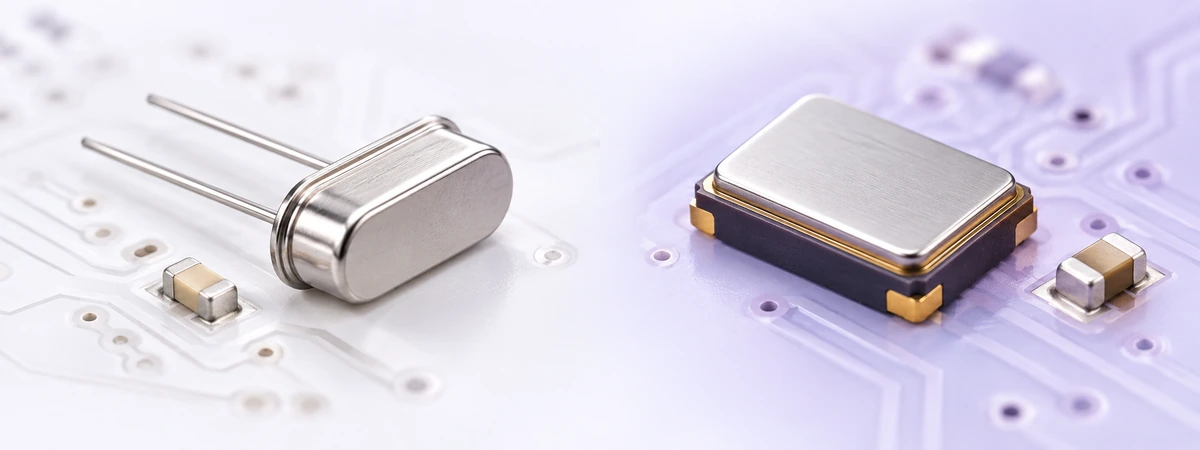
A passive quartz crystal requires an external sustaining circuit. AEC-Q200 Rev. E includes quartz-crystal requirements in Table 11, covering stresses such as temperature cycling, vibration, mechanical shock, soldering heat and ESD. Use the applicable table and agreed electrical limits when reviewing results. [2]
Revision E does not automatically invalidate earlier qualifications: it permits previously qualified components to remain qualified and specifies how changes are handled. Reports must identify the revision used. This makes revision review more useful than rejecting a report solely because it predates Revision E. [2]
Do not apply an IC temperature-grade label to a crystal without checking its documentation. Confirm the crystal’s stated operating range and the conditions under which its electrical performance is guaranteed.
What IATF 16949 certification means
IATF 16949:2016 is an automotive quality management system standard that replaced ISO/TS 16949:2009. It is used with ISO 9001:2015; the two documents form the basis for the combined requirements. [3] [4]
Certification concerns the quality management system within its stated scope. Treating it as a qualification report for every catalogue item would extend that evidence beyond its purpose. For procurement, match the certificate’s organization and location to the proposed manufacturing source, then review product evidence separately.
Customer requirements also matter. IATF’s official FAQ explains that an organization must evaluate requirements from its direct customers, including applicable customer-specific requirements. The IATF website publishes OEM requirement documents, while additional requirements may be supplied directly by a customer. [4] [5]
Use the applicable sanctioned interpretations alongside the standard. Their role differs from an FAQ: a sanctioned interpretation changes how a requirement is interpreted and can affect conformity assessment. [6]
A practical purchasing review
We recommend organizing the review around the proposed part and its intended use. The following questions help turn a broad “automotive-grade” request into a clear engineering discussion:
- Identify the part. State the complete ordering code, frequency, package and temperature option. Ask the supplier to identify any options excluded from the submitted evidence.
- Define the application. Describe the installation location, expected temperature exposure, operating hours, vibration environment and assembly process. Separate operating conditions from storage and short-duration excursions.
- Request a document map. List the datasheet, qualification report, system certificate and customer approval documents together with their revision, owner and coverage.
- Resolve technical gaps. Ask for an explanation of missing tests, exceptions or family-level evidence. Record the engineering decision and any additional validation agreed with the supplier.
- Agree production requirements. Confirm the required production part approval process (PPAP) submission, traceability information and change-notification arrangements with the responsible customer quality team.
- Close the application review. Assign responsibility for circuit and system validation before release. Keep the approval decision with the exact part specification used for purchasing.
For timing components, also define what the circuit needs: frequency accuracy, start-up behavior and the relevant electrical interface. A qualification label cannot replace a complete purchasing specification. Where a requirement is critical, state its test conditions and acceptance limit explicitly.
Frequently asked questions
Does AEC issue product certificates?
AEC-Q100 and AEC-Q200 both state that AEC does not operate a certification board for qualifying parts. Suppliers provide qualification evidence for customer review. A supplier or laboratory document should therefore be assessed by its scope and results. [1] [2]
Does a factory certificate cover every oscillator?
No. Ask for evidence covering the proposed oscillator ordering code in addition to the manufacturing site’s quality management certificate. Keep the two reviews distinct in the approval record.
What should I send with a quotation request?
Include the target frequency, component type, package, operating conditions, electrical requirements and required qualification documentation. Identify the customer approval process early so that document expectations are clear before part selection.
Discuss your timing requirements with FCom
Send your application requirements and proposed part number to FCom@fujicrystal.com. Please specify the qualification reports and customer approval documents required for your project so that the review can focus on the relevant product and manufacturing scope.
Technical references
- AEC-Q100 Rev. J — IC qualification (PDF). August 11, 2023. AEC document copy hosted by Guerrilla RF; see Sections 1.3 and 2.3.
- AEC-Q200 Rev. E — Passive-component qualification (PDF). March 20, 2023. AEC document copy hosted by ICE Components; see Sections 1.1 and 1.5, and Table 11.
- IATF — About IATF 16949:2016.
- IATF 16949:2016 — Official FAQs (PDF). November 2025; see FAQs 1 and 8.
- IATF — Customer-specific requirements.
- IATF 16949:2016 — Sanctioned interpretations.