
FCom · Audio clock selection
Audio clock crystals and oscillators
Explore 22.5792, 24.576, 45.1584, 49.152, 90.3168 and 98.304 MHz timing options for 44.1 kHz and 48 kHz audio sample-rate families. Compare complete CMOS oscillators and quartz resonators, then match the component to your clock architecture.
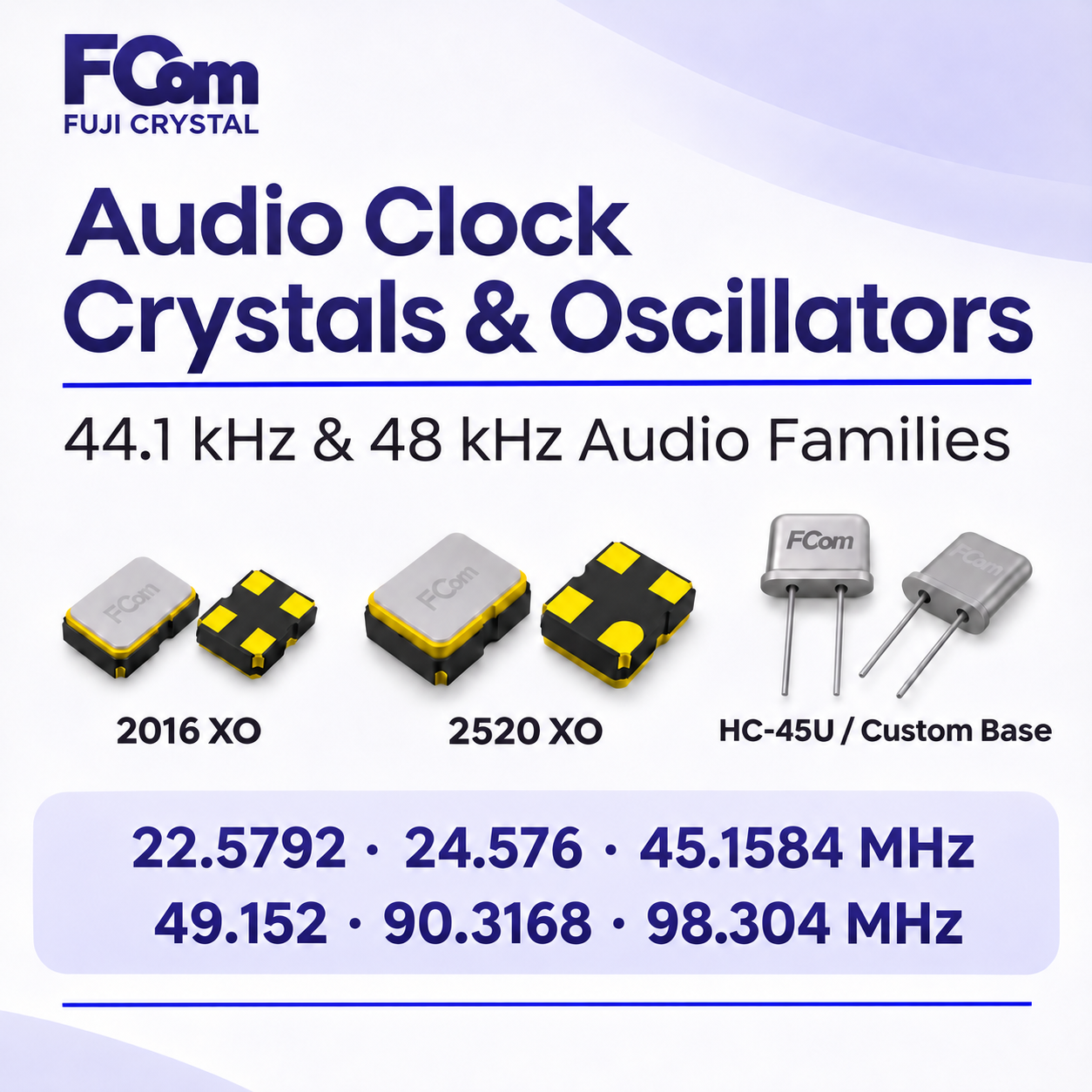
Choose your audio clock frequency
Start with the sample-rate family, then check the receiving device’s supported master-clock frequencies, input levels and division ratios. The six entries below are separate design options.
| Clock frequency | Sample-rate family | Example frequency ratio | Component route | Selection |
|---|---|---|---|---|
| 22.5792 MHz | 44.1 kHz family | 44.1 kHz × 512 | CMOS XO · 2016 / 2520 | View option |
| 24.576 MHz | 48 kHz family | 48 kHz × 512 | CMOS XO · 2016 / 2520 | View option |
| 45.1584 MHz | 44.1 kHz family | 44.1 kHz × 1024 | CMOS XO · 2016 / 2520 | View option |
| 49.152 MHz | 48 kHz family | 48 kHz × 1024 | CMOS XO · 2016 / 2520 | View option |
| 90.3168 MHz | 44.1 kHz family | 44.1 kHz × 2048 | Quartz crystal · HC-45U / custom base | View option |
| 98.304 MHz | 48 kHz family | 48 kHz × 2048 | Quartz crystal · HC-45U / custom base | View option |
Frequency ratios describe mathematical relationships. Confirm the receiving IC’s accepted clock frequency and operating mode before selecting a component.
2016 and 2520 low jitter oscillator options
Choose a 2016 (2.0 × 1.6 mm) or 2520 (2.5 × 2.0 mm) package for 22.5792, 24.576, 45.1584 or 49.152 MHz audio clocks. The four recommended FCO2C part numbers below use the 2520 package. For a 2016 package, request the corresponding ordering configuration and specification.
Recommended part numbers
2016 / 2520 package options
22.5792 MHz crystal oscillator
44.1 kHz × 512 audio clock · listed FCO2C part number uses the 2520 package
- Package
- 2520 · 2.5 × 2.0 mm
- Supply
- 3.3 V nominal
- Output
- CMOS
2016 / 2520 package options
24.576 MHz crystal oscillator
48 kHz × 512 audio clock · listed FCO2C part number uses the 2520 package
- Package
- 2520 · 2.5 × 2.0 mm
- Supply
- 3.3 V nominal
- Output
- CMOS
Recommended 2520 configuration
45.1584 MHz crystal oscillator
2520 configuration: RMS phase jitter, integrated from 12 kHz to 20 MHz
- Package
- 2520 · 2.5 × 2.0 mm
- Supply
- 3.3 V ±10%
- Output
- CMOS
Recommended 2520 configuration
49.152 MHz crystal oscillator
2520 configuration: RMS phase jitter, integrated from 12 kHz to 20 MHz
- Package
- 2520 · 2.5 × 2.0 mm
- Supply
- 3.3 V ±10%
- Output
- CMOS
2016 package configuration
Specify a 2.0 × 1.6 mm package for 22.5792, 24.576, 45.1584 or 49.152 MHz. The recommended FCO2C codes shown above identify 2520 parts; contact FCom for the corresponding 2016 ordering code. Share the supply voltage, output load, temperature range and phase-noise or jitter target to confirm the configuration.
Review phase noise for your clock path
Specify the offset frequencies and integration bandwidth that matter to your system. Request carrier-specific phase-noise plots and include close-in offsets such as 10 Hz and 100 Hz when they form part of your design target.
Quartz crystals with configurable packages
Explore HC-45U or custom-base options for 90.3168 and 98.304 MHz crystal requirements. FCom can review the mechanical outline, mounting arrangement and crystal design to match your oscillator assembly.
Passive quartz resonator
90.3168 MHz crystal resonator
Quartz resonator · Configurable package
Choose the package and base design to match your oscillator assembly.
- Package
- HC-45U option
- Base
- Custom design
- Outline
- Project-specific
Passive quartz resonator
98.304 MHz crystal resonator
Quartz resonator · Configurable package
Choose the package and base design to match your oscillator assembly.
- Package
- HC-45U option
- Base
- Custom design
- Outline
- Project-specific
Applications and design-in guidance
Match the clock source to the system architecture, the receiving device and the noise budget. FCom can review the component requirements for your audio timing path.
DAC and ADC clock paths
Review the converter’s accepted MCLK frequencies, clock ratios, input levels and timing requirements. Select a direct oscillator output or an appropriate crystal-based clock circuit.
USB audio interfaces
Separate audio clock requirements from the USB controller’s own reference clock. Identify the sample-rate families and the clock-generation or distribution stages used by your design.
Custom audio clock generators
For discrete oscillator and divided-clock architectures, specify the resonator mode, resonance condition, drive level and required output performance at the receiving device.
Using a complete CMOS oscillator
- Select a 2016 or 2520 package and confirm its pin functions and electrical specification.
- For the documented 45.1584 and 49.152 MHz 2520 configurations, review the 3.3 V supply, CMOS thresholds, 15 pF load and Tri-State control. Confirm the frequency-specific electrical requirements for 22.5792 and 24.576 MHz.
- Place a 0.1 µF bypass capacitor close to VDD and GND pads.
- Include clock buffers, routing and power-supply noise in the system timing review.
Using a configurable quartz crystal
- Choose HC-45U or a custom base to fit the oscillator assembly.
- Confirm the crystal cut, resonance condition and intended oscillation mode.
- Evaluate startup margin and crystal drive across operating conditions.
- Measure the completed oscillator’s phase noise and jitter against the system target.
Frequently asked questions
How do I choose between these six clock frequencies?
Start with the audio sample-rate family and the receiving device’s clock requirements. 22.5792, 45.1584 and 90.3168 MHz are integer-related to 44.1 kHz; 24.576, 49.152 and 98.304 MHz are integer-related to 48 kHz. Select an accepted input frequency, then confirm division ratios, voltage levels and operating mode.
Which package options can I select?
22.5792, 24.576, 45.1584 and 49.152 MHz CMOS oscillators offer 2016 or 2520 package options. The four listed FCO2C part numbers identify recommended 2520 configurations; request the corresponding ordering code for a 2016 package. For 90.3168 and 98.304 MHz quartz crystals, discuss HC-45U or a custom base matched to your assembly and electrical requirements.
Should I use a crystal resonator or a complete oscillator?
A complete oscillator combines a resonator with oscillation circuitry and provides a clock output when powered. A crystal resonator connects to an external oscillator circuit. Review startup, mode selection, drive conditions and output performance for that circuit.
How should I compare phase-noise and jitter specifications?
Compare data at the same carrier frequency, supply voltage, load and measurement bandwidth. The listed 45 fs typical RMS phase jitter applies to FCO2C33CDYLN-45.1584MHz and FCO2C33CDYLN-49.152MHz, using a 12 kHz–20 MHz integration range. Request frequency-specific jitter and phase-noise data for the 22.5792 and 24.576 MHz configurations. Assess close-in phase noise separately when it matters to the design.
Can FCom help with selection and evaluation samples?
Send your target frequency, component type, electrical requirements, temperature profile and evaluation quantity. FCom can review the configuration, discuss the appropriate documentation and confirm sample availability, pricing and lead time.