



Definition and Characteristics of Large-Scale Data Centers
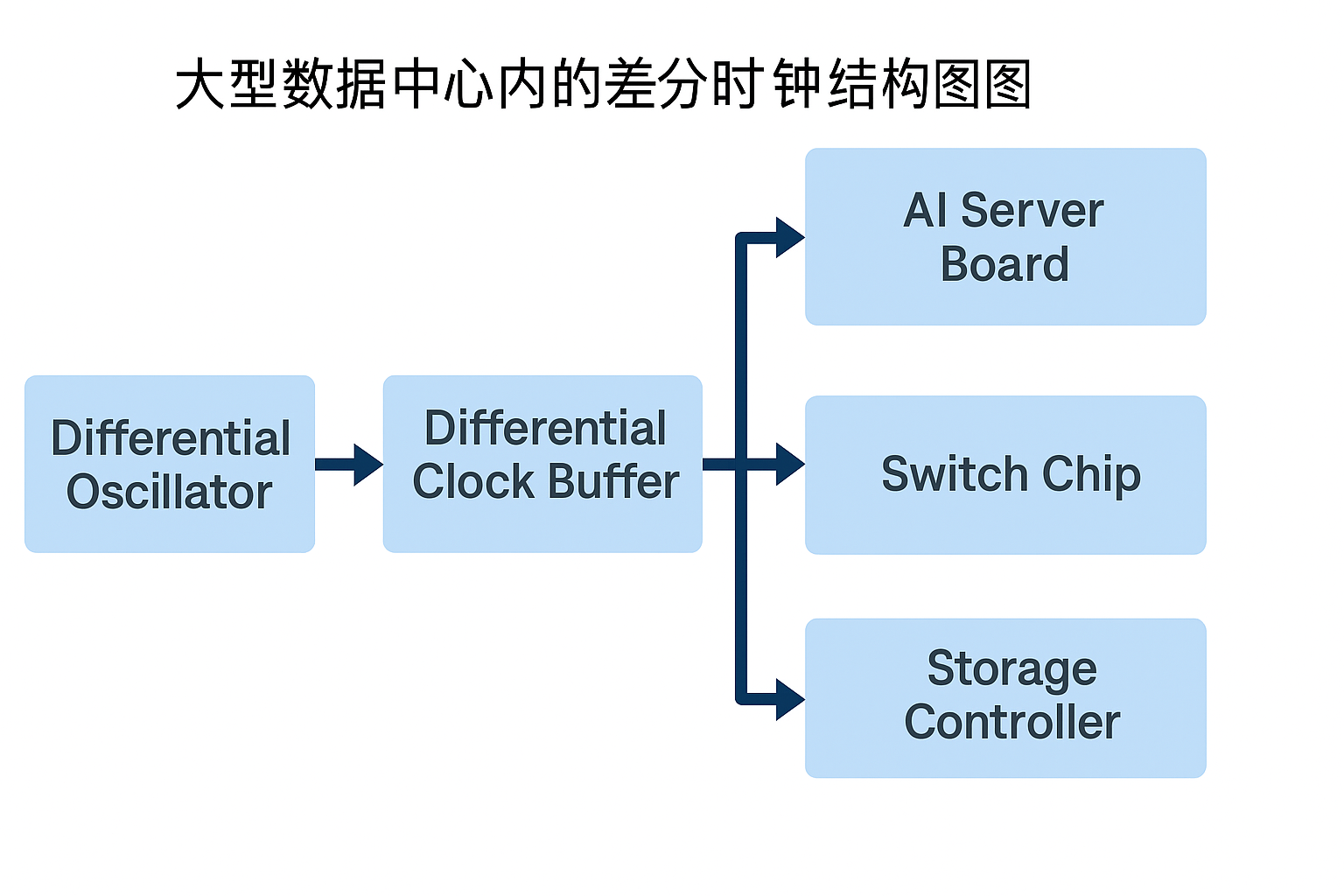
Large-scale data centers typically contain 200 to thousands of server racks, deploying tens of thousands of servers and storage devices. They support mission-critical applications such as cloud computing, large AI model training, global CDN backbones, and financial risk control systems. These centers demand extreme performance in network bandwidth, storage throughput, latency control, and system reliability. Core systems rely on precise synchronization, where differential crystal oscillators serve as fundamental clock sources.
Typical Cases of Large-Scale Data Centers
1. Hyperscale Cloud Computing Platforms (e.g., AWS, Alibaba Cloud, Tencent Cloud)
Application Background: Supports massive user access, cross-regional CDN deployment, AI inference and training, and cloud database services in large-scale distributed environments.
Equipment Used: Spine-Leaf core switching networks, AI acceleration servers (NVIDIA H100/800), high-capacity SSD clusters, RDMA NICs, InfiniBand switches, time synchronization modules.
2. Financial High-Frequency Trading Data Centers
Application Background: Supports sub-millisecond trade execution and market data distribution, requiring system-wide low latency and high jitter suppression capability.
Equipment Used: FPGA market data processing cards, ultra-low latency switches, 25G/100G optical modules, NVMe high-speed storage, precision clock distribution systems (IEEE1588/PTP).
3. AI Supercomputing Centers (e.g., OpenAI, Baidu ERNIE)
Application Background: Trains trillion-parameter AI models involving thousands of GPU nodes interconnected via ultra-high-speed NVLink, PCIe Gen5/6 interfaces, requiring cluster clock synchronization.
Equipment Used: AI servers, HPC interconnect fabrics, optical modules, distributed storage, RDMA NICs, programmable oscillators, low-jitter synchronization modules.
Typical Equipment and Matching Solutions
1. Spine/Leaf High-Speed Switching Networks
Matching Solution: FCO-5L 156.25MHz LVPECL Output
Chip Models: Broadcom Tomahawk 4/5, Marvell Teralynx
Matching Rationale: Supports 400G/800G links where switching chips require ultra-low jitter (<0.2ps) clocks for SerDes. FCO-5L offers high stability and industrial temperature support.
Layout Recommendation: Use short traces in SerDes areas with equal-length differential pairs placed close to the chip.
2. AI GPU Server and Motherboard Clocks
Matching Solution: FCO-7L 100MHz HCSL Output
Chip Models: NVIDIA H100, AMD Instinct MI300, Intel Sapphire Rapids
Matching Rationale: GPU motherboards require HCSL clocks for PCIe Gen5/6. FCO-7L meets ±25ppm frequency stability and <0.3ps jitter requirements for signal integrity.
Layout Recommendation: Position near clock buffers between CPU/GPU with continuous ground reference plane.
3. High-Performance NIC and RDMA Cards
Matching Solution: FCO-3L 125MHz LVDS Output
Chip Models: Intel E810, NVIDIA ConnectX-6/7, Broadcom NetXtreme
Matching Rationale: RDMA is latency-sensitive requiring high-precision differential oscillators. FCO-3L supports 3.3V/2.5V compatibility.
Layout Recommendation: Symmetric routing to PCIe buffers with AC-coupled oscillator output.
4. QSFP-DD/OSFP Optical Modules
Matching Solution: FCO-2L 161.1328125MHz LVDS Output
Chip Models: Semtech GN2104, MACOM MAOM-003419, MaxLinear MxL9354
Matching Rationale: Supports PAM4 high-speed transmission with strict jitter tolerance. FCO-2L features compact packaging and low power consumption.
Layout Recommendation: Keep trace to CDR module <10mm with proper termination and EMI-minimized routing.
5. Distributed Storage Controllers
Matching Solution: FCO-5L 100MHz LVPECL Output
Chip Models: Broadcom MegaRAID, Microchip Flashtec NVMe 3108
Matching Rationale: RAID controllers demand high frequency stability. FCO-5L provides <0.2ps jitter for redundant synchronization.
Layout Recommendation: Isolate clock domains from main controller and avoid crossing high-speed signals.
Conclusion
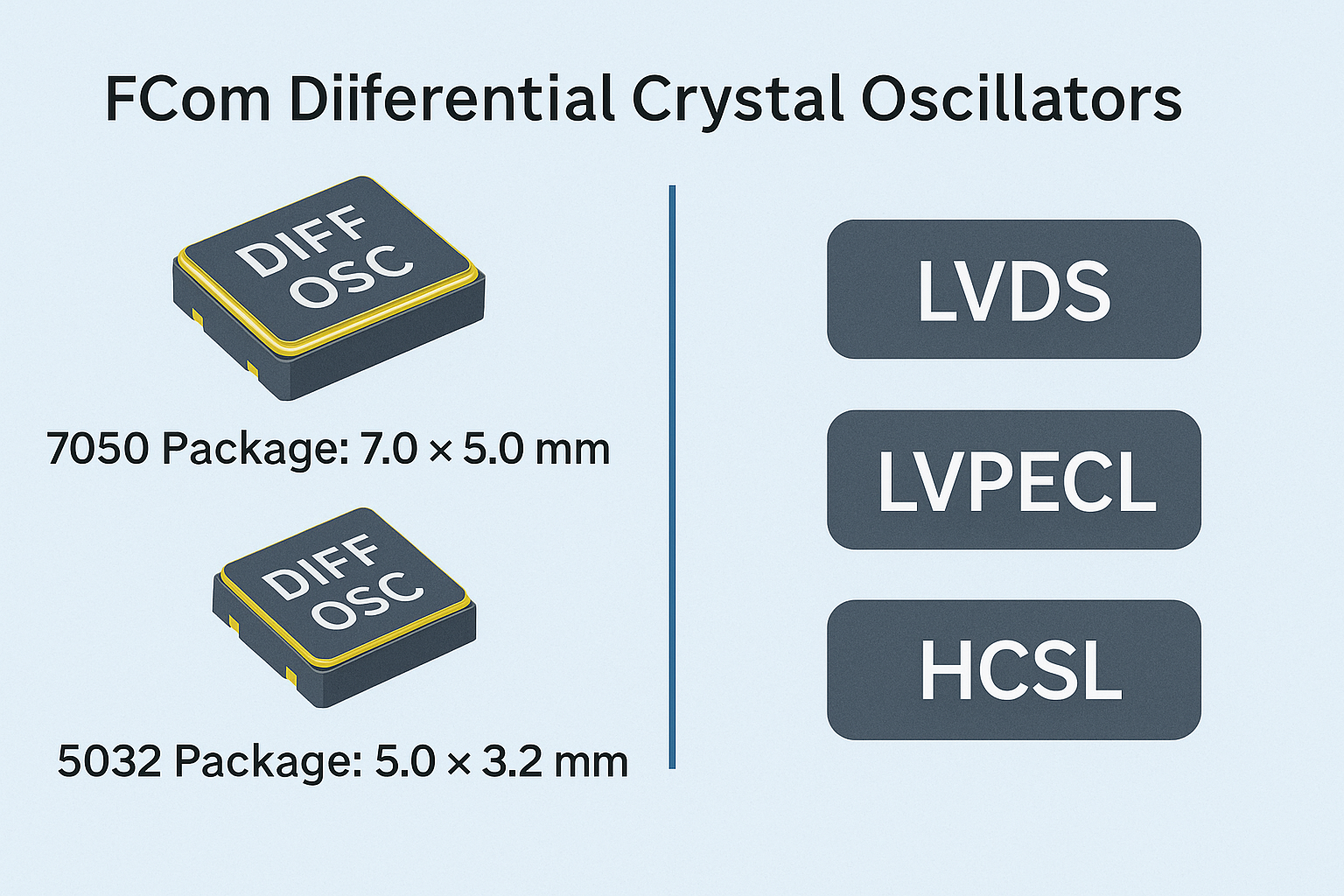
In large-scale data centers—whether AI clusters, financial systems, or global cloud platforms—clock synchronization and stability are fundamental for ensuring high throughput and secure operation. FCom differential crystal oscillators demonstrate low jitter, wide temperature tolerance, and multi-package compatibility across high-performance nodes, making them the preferred choice for reliable clock systems.
Through chip-level compatibility optimization and proper PCB layout practices, FCom FCO series differential oscillators provide critical support for building high-performance data center networks, storage controllers, and AI computing platforms, serving as essential components for system stability.
